

Hello, Admin Unicorns. Greetings from the other side of the abyss! Sorry for dropping off the face of the earth for a while there. I hit a super low point emotionally in December, and I have been working on climbing out of it ever since.

I’m just going to put it all out there; like many people (6.7% of all U.S. adults in 2015), I live with chronic depression (among other mental health issues). This isn’t new for me; I was diagnosed when I was young, so it’s definitely not my first time on the mental health roller coaster. My depression often manifests at the beginning of the new year and lingers through April or May. Sometimes I’m able to manage it with mindfulness, meditation, and “changing the tapes.” Sometimes I need head meds to boost me out of the slump.
Many of us have been indoctrinated with the notion that you shouldn’t bring your personal issues to work, so we try hard to hide our depression (or anxiety or PTSD or bipolar disorder, etc.). Because there is so much stigma associated with mental illness, I feel it is important to speak candidly about it. Part of the reason I haven’t posted here in a while is because I’ve needed to use all of my very limited energy (or spoons) on continuing to provide excellent support to my bosses and colleagues. The fact that I really love my job gives me a reason to strive to push through the depression fog and at least be present for that. Everything else tends to slide right off my plate.
There are a lot of articles on the interwebs with great suggestions on how to cope with depression on the job. This wikiHow to Be Productive at Work when You’re Depressed article in particular has many excellent suggestions.
Here is a list, in no particular order, of things that help me when I’m trying to work though the depression:
- Exercise. It usually feels nearly impossible to get moving when I am depressed. And the fact that I know I need to be moving, but I’m finding it near impossible to do so, can make me feel even worse. Small goals are much more manageable than big goals. Even if I can only do five minutes on my exercise bike a day, I consider it a win. And if I do five minutes one day it sometimes leads to 10 minutes the next day.
- Natural light. Daily exposure to natural light has proven to help elevate one’s mood. I am lucky that my cubicle is next to a window. If your work space isn’t near a window, and you have the option to move, I say do it. If not, make sure to take regular breaks outside. Just spending a few minutes a day outside will make a difference. You can also try getting a lamp that mimics natural sunlight. Also, I have a USB Mini Himalayan Salt Lamp on my desk that helps provide a little extra light, and some people believe that keeping a crystal salt lamp next to your computer helps counter unhealthy electromagnetic fields (EMF’s) from computers and wireless devices.

- Personalize your work space. I like to surround myself with photos of loved ones, bright colors, shiny and sparkly objects, and plants. I particularly enjoy succulents and air plants. I recently purchased a few of these super neat Air Plant Geode Crystals from Prismatic Gardens, and they look great on my desk! Having pretty things on my desk to look at definitely helps elevate my mood.
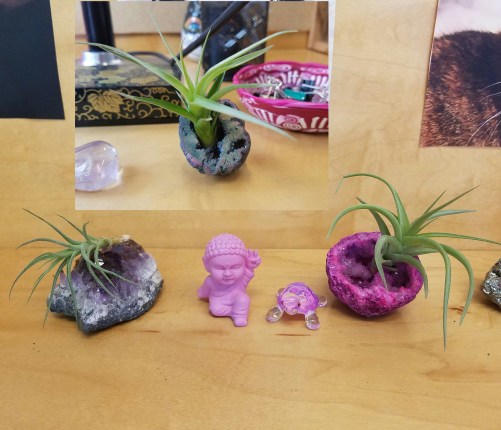
Sparkly happiness on my desk 🙂

It’s a little harder to be sad when you look at this face every day.
- Listen to music. Sometimes putting on some noise-canceling headphones and listening to some of my favorite tunes while I work helps lighten my mood. Depending on the level of focus needed for a particular task and my anxiety level at that moment, I will listen to anything from punk rock to hip hop to show tunes to meditation music. Sometimes I’m surprised to catch myself happily humming along.
- Task lists. When I’m depressed it is easy to feel overwhelmed by all the things I need to do at work. Even on my best days I like task lists, so when I’m feeling overwhelmed I open my task list and sort everything by priority and deadline. Since I support multiple people, I also love color-coding my tasks by person or department. If a certain task seems too big, I break it down into smaller steps. If I am afraid I can’t make a deadline I find out if the deadline is flexible. Seeing everything I need to get done all organized and color coded brings me a sense of peace and makes it all seem so much more manageable.
- If possible, confide in a co-worker, supervisor, or someone in your HR department. I am blessed to work with the best office manager ever. I am grateful that I can confide in her when I am struggling, and sometimes she will cover for me when I need help with certain tasks. She’s even learned not to approach me from behind so as not to trigger my PTSD. My supervisor is also extremely supportive, and it is easy to be honest with her. If you can find at least one colleague that is empathetic to what you are going through try to reach out to them. Sometimes just being able to say to someone “I am struggling today” can bring some relief. If your supervisor is cool, try talking to them. Let them know what you are going through. They may be able to help you strategize how to best get your work done or what you might be able to delegate to someone else when you’re having a hard time. If you don’t feel comfortable confiding in a colleague, talk to a friend.
- Mental health days. If your company offers PTO, and you need to take some time for yourself, do it. Some days I just can’t adult. On those days I take a mental health day. Also, sometimes the hardest part of work for me is getting there. Commuting can be exhausting. If you have the option, occasionally working from home can help relieve the stress of commuting and can save you a few spoons. Just be mindful that part of depression often involves isolating oneself, and if you do that too much it can exacerbate your symptoms.
- Consult a medical professional. Sometimes you gotta suck it up buttercup and go to the doctor or community clinic. A medical professional can help you decide your next steps, which may include therapy or medication.
Most importantly, if you are having suicidal thoughts please please please reach out to someone.
If you’ve lost a loved one to suicide there is an excellent support network called SOLOS: Survivors Of Loved Ones to Suicide.
Resources
Depression, PTSD, & Other Mental Health Conditions in the Workplace: Your Legal Rights
How To Cope With Depression At Work
Dealing With Depression at Work: What You Need to Know
Coping with Depression: Self-Help Tips to Deal with and Overcome Depression
Please feel free to comment and share your most effective strategies for getting through your work day while coping with depression.

 The Admin Unicorn